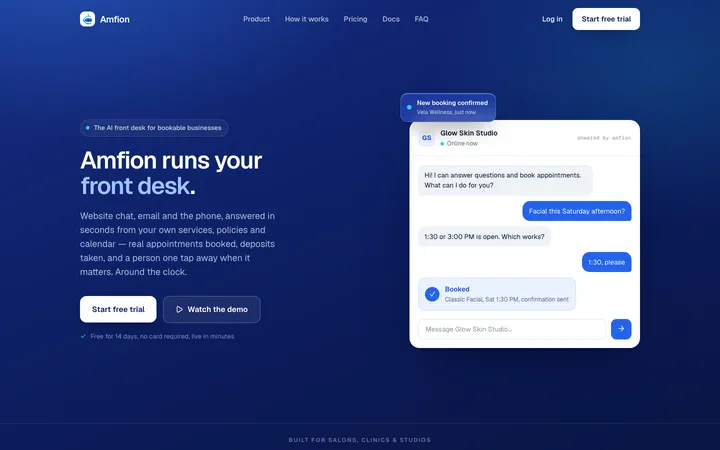
Amfion is operated by Amfion LLC. Force Digital built the product's public positioning, search architecture, website experience, and lead path alongside the underlying product work. This case study covers that build relationship. It does not claim ranking, revenue, or conversion gains that have not been measured and published.
The relationship
Amfion and Force Digital are affiliated projects with a shared builder. That connection gives Force Digital direct access to the product decisions behind the public site, not just the finished marketing layer.
The brief was to explain a real operational system in plain language. Amfion spans website chat, email, phone, booking pages, calendars, deposits, appointment changes, and human takeover. A generic “AI chatbot” label would have hidden the most important part: the assistant must work inside business rules and stop when a person is needed.
The product challenge was clarity without simplification
Customer-facing AI is easy to describe vaguely. The harder task is showing what the system actually does, what information it uses, and how a booking becomes a real calendar event.
The public experience needed to answer four questions quickly:
- Which customer channels can Amfion answer?
- How does it use a business's services, policies, and availability?
- What makes a booking more than a message in a chat window?
- How can an owner step in when the conversation needs judgment?
Those questions became the information architecture for the homepage, product pages, security material, guides, and conversion paths.
Position the job, not the novelty
The central position is “AI front desk for bookable businesses.” It describes the business job before the technology. Supporting pages then explain the narrower capabilities: answering from approved information, checking availability, reserving appointments under booking rules, taking deposits where configured, and handing the thread to a person.
That product language also creates a better search system. A potential customer can enter through a page about AI booking assistants, a page for a specific business type, an integration guide, or the main product story and still reach the same core explanation.
Make product proof visible
A polished claim is not enough for an operational product. The public system uses several proof surfaces with different jobs:
- The About page defines the company and the product in verifiable terms.
- The Security page documents concrete controls and current limits.
- The changelog records shipped work instead of presenting a roadmap as a feature list.
- Demonstration activity is labeled as an example.
- The booking-value calculator makes clear that its inputs are the visitor's assumptions, not published Amfion performance.
This is ongoing editorial work. New capability and industry pages still need the same claim review before they become durable proof.
Connect search architecture to the product
The site uses crawlable routes, descriptive metadata, structured data, internal links, and a shared page system for product, industry, comparison, integration, and guide content. The goal is not to manufacture many pages. Each route needs a distinct decision or question to answer.
The strongest path joins the search promise to the actual product. A page about booking assistants should lead to a demonstration of booking. A page about calendar integration should explain the supported connection and the setup path. A page about customer handoff should show where automation stops.
This is the same principle behind Force Digital's AI booking guide for local businesses: give the system one clear job and design the human boundary first.
What shipped
- A concrete “AI front desk” product position tied to bookable businesses.
- A public website organized around channels, booking, source-grounded answers, and handoff.
- About, Security, and Changelog pages that carry different kinds of product evidence.
- A reusable search-page system with canonical metadata and structured data.
- Direct paths from education and product explanation to trial and product exploration.
- An editorial rule that separates examples, assumptions, shipped capability, and measured outcomes.
What we learned
A strong AI product site does not need more AI language. It needs clearer operating boundaries. The visitor should know which facts the assistant can use, what makes a booking valid, and when a human takes over.
Building the product and the public experience together also exposes weak marketing language quickly. If a claim cannot be connected to a shipped capability, a public control, or measured evidence, it should be narrowed before it becomes part of the acquisition system.