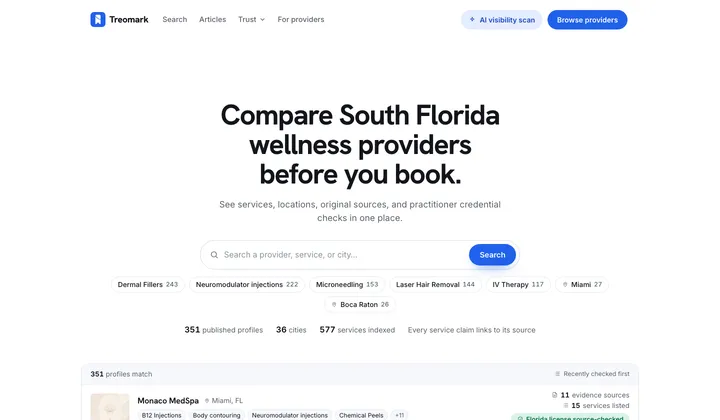
Treomark's public product experience and evidence-publishing system were developed with Force Digital around one rule: a provider fact should stay connected to the evidence behind it. This case study explains that system. It does not claim traffic, ranking, or provider-acquisition results.
The relationship
Treomark and Force Digital are affiliated projects with a shared builder. Force Digital developed the public website, search architecture, structured-data system, and the paths that help providers understand and improve their public information.
That relationship is stated openly because the useful part of the case study is the implementation itself: how a source-connected dataset becomes a navigable, accountable public experience.
The research problem was bigger than a directory
Most provider directories compress a business into a name, a rating, and a marketing paragraph. Treomark needed to preserve more of the evidence chain. A reader should be able to see the listed service, the source behind it, when key facts were checked, and whether a public practitioner credential record was found.
The platform also needed to distinguish several kinds of information:
- Provider-published services and contact details.
- Public records and practitioner credential checks.
- Treomark's research notes and review dates.
- General educational content that does not replace medical advice.
- Provider-facing visibility guidance that is separate from consumer research.
Design for inspection, not a trust badge
Trust cannot be reduced to a decorative seal. Treomark profiles keep supporting sources and review context close to the claim they describe. Comparison views line up published facts without inventing a universal score for quality.
The interface uses plain status language, source links, dated checks, correction paths, and visible methodology. This gives the reader more than a conclusion. It gives them a route to inspect the basis for it.
Turn structured data into useful pages
The public architecture connects provider profiles with service and city collections, comparison tools, research reports, consumer articles, and provider resources. Every route has a specific job and a canonical destination.
Server-rendered HTML, descriptive headings, internal links, and schema help search and answer systems understand the same information a reader can see. The structured data describes the visible page rather than adding claims that exist only for crawlers.
This approach is a working example of the principles in Force Digital's generative search guide for local businesses: publish firsthand structure, keep claims verifiable, and connect related decisions with natural internal links.
Separate research from promotion
Treomark has several audiences, and mixing them would weaken the product. Consumer profiles and research pages need evidence and correction controls. Provider pages can explain claiming, visibility, and participation. Editorial standards and methodology pages define how automation, human review, attribution, and changes are handled.
That separation is also important for Force Digital. A case study can explain the product and link to it, but it should not turn Treomark's medical or credential research into an agency promotion surface.
What shipped
- Source-connected provider profiles with services and dated review context.
- City and service collection pages built from accepted public data.
- Provider comparison views that preserve the underlying evidence.
- Public methodology, editorial standards, correction, and research surfaces.
- Consumer articles and provider resources kept in separate information paths.
- Structured data and internal links aligned with information visible on each page.
What we learned
Search visibility and public trust improve for the same basic reason: the information becomes easier to inspect. Clear entities, specific services, original sources, review dates, and correction paths help people and machines understand what a page can support.
The hard part is not generating more pages. It is maintaining the relationship between each page and the accepted evidence beneath it as providers, sources, and public records change.